


Blog
Humidity & Heritage: Upgrading Greensboro's Historic Wiring For Heatwaves
Greensboro's older neighborhoods are some of the most beautiful in the Piedmont Triad: wraparound porches, original heart-pine floors, plaster walls that have stood for a century. But behind those walls, the electrical systems in many of these homes were designed for a world without central air conditioning. When a summer heatwave settles in and the humidity climbs, that gap between the past and the present becomes a serious safety problem.
Historic Home Wiring Failure Summary
- Greensboro's historic neighborhoods (Fisher Park, College Hill, Sunset Hills) commonly harbor knob-and-tube or cloth-jacketed wiring that lacks a grounding pathway and can't safely carry modern HVAC loads
- Summer heat pushes attic temperatures to 130°F or higher, baking aging wire insulation from the outside while peak electrical demand stresses it from within
- Undersized 60- or 100-amp panels can't supply enough current to run a modern central air system or heat pump without tripping breakers or creating arc-fault hazards
- A licensed electrical contractor familiar with Guilford County permitting can rewire a historic home without destroying original plaster, molding, or trim
- Ductless mini-split systems pair particularly well with historic home rewiring; they eliminate the need for ductwork entirely
Table of Contents
- The Perfect Storm: Why Summer Humidity and Heatwaves Overburden Vintage Wiring
- 3 Major Electrical and HVAC Pitfalls Faced by Greensboro's Historic Homes
- Behind the Plaster: What a Modern, Non-Invasive Rewiring Process Looks Like
- Invisible Integration: How Professional Rewiring Preserves Historic Architecture
- Does Your Historic Home Have Wiring Issues?
The Perfect Storm: Why Summer Humidity and Heatwaves Overburden Vintage Wiring
A Piedmont summer heatwave taxes even a well-maintained modern electrical system. In a house built before 1960, the physics get genuinely dangerous.
Copper wire heats up when it carries current. That's normal. But in an old home with uninsulated attic cavities, the wire is also being baked from the outside. Attics in neighborhoods like Sunset Hills and Latham Park, packed with brick Tudors and stone cottages built in the 1920s and 1940s, can reach 130°F to 140°F during the hottest weeks of the year. When the AC is running continuously to fight a 95-degree afternoon, that wiring is fighting heat from two directions at once.
The humidity compounds things. The Triad's summer air is heavy, and in unventilated wall cavities it speeds up the degradation of aging insulation. The cloth jacketing that replaced knob-and-tube in mid-century homes was an improvement at the time. After 80-plus North Carolina summers sealed inside a hot wall, it often turns brittle and flakes away, leaving bare copper exposed. When that happens, the wire isn't protected. It's a fire waiting for the right conditions.
These are the conditions that produce heatwave power failure solutions Greensboro homeowners end up needing in July, when the system finally gives out. Having a licensed electrician assess the wiring before that point is the better call.
3 Major Electrical and HVAC Pitfalls Faced by Greensboro's Historic Homes
The hazards behind the walls of pre-1960s properties aren't random; they follow predictable patterns. Homes in Fisher Park, College Hill, and the older Advance-area farmhouses in Davie County tend to present the same three problems.
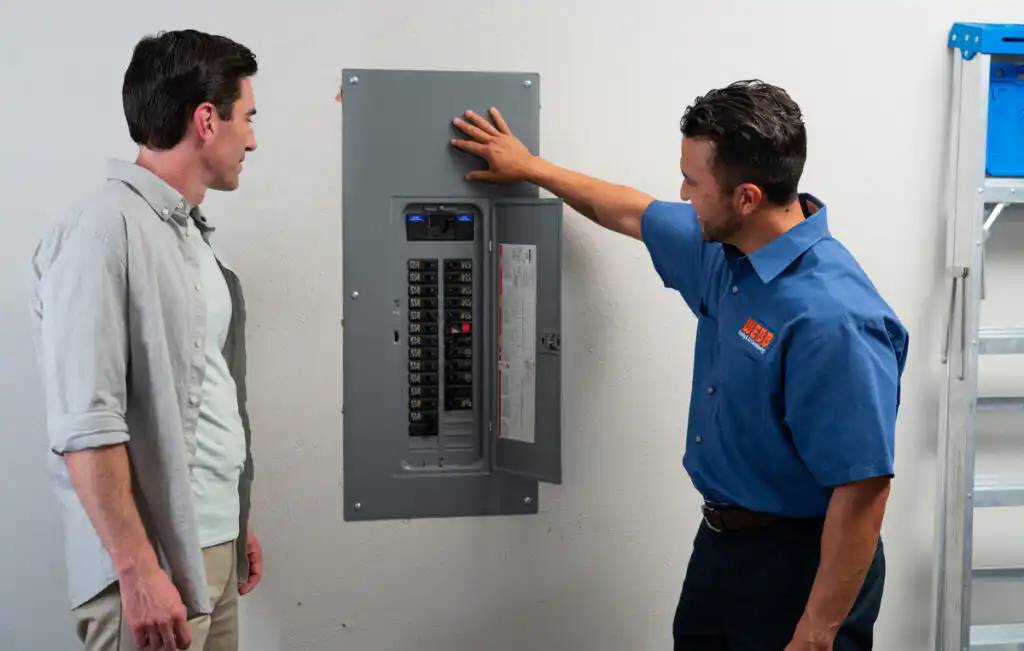
- The 60-amp/100-amp bottleneck: Many historic homes still have undersized electrical panels with original or early-replacement service. A modern home running central air and a heat pump typically requires 200-amp service to carry the combined load without constantly tripping breakers. When an undersized panel tries to supply peak HVAC demand alongside everyday appliances, something gives. Addressing historic home electrical wiring Greensboro NC means starting with the panel.
- Ungrounded knob-and-tube or cloth-jacketed wiring: Pre-1940s homes in Fisher Park and College Hill frequently still contain knob-and-tube wiring buried under layers of blown-in attic insulation, which is a fire hazard because knob-and-tube needs open air to dissipate heat. Neither knob-and-tube nor early cloth-jacketed wiring includes a grounding pathway. That leaves modern HVAC control boards, smart thermostats, and any other sensitive electronics vulnerable to voltage spikes. Electrical repair on these systems requires a full rewire, not a patch.
- The dangerous daisy-chain: Original layouts in historic homes had far fewer wall outlets than modern life requires. Over the decades, different owners added extensions: DIY wiring run out to back porches, detached garages, or barns, especially common on the larger rural properties in Advance and rural Davie County. If a past owner installed a higher-amp fuse or breaker to stop a circuit from tripping, the thin wire behind it is now unprotected against overcurrent. That's an arc-fault condition that can ignite inside a wall with no visible warning.
Any one of these problems on its own warrants an inspection. In a lot of older Triad homes, all three show up in the same panel.
Behind the Plaster: What a Modern, Non-Invasive Rewiring Process Looks Like
The most common fear homeowners in historic districts express is that rewiring means opening up walls. In most cases, it doesn't. HVAC electrical upgrades for older homes have evolved considerably, and a competent crew with the right equipment can do this work without gutting plaster.
- Phase 1: Load calculation and permitting. Before a wire is touched, a licensed contractor calculates the home's total electrical load (HVAC equipment, appliances, lighting) and determines what the new service needs to support. In Greensboro, this also means pulling the necessary permits with Guilford County. You can't legally restore power after a panel upgrade until a county inspector signs off. A professional team manages the entire permitting loop, so the homeowner isn't left without AC while paperwork sits unresolved.
- Phase 2: Panel upgrade and grounding. The old box comes out and a modern, code-compliant 200-amp breaker panel goes in. This includes dual grounding rods that give stray voltage a safe exit path. Where the panel lands matters too. In historic districts, Greensboro Historic Preservation Commission guidelines don't regulate interior electrical work, but they do cover the exterior. A gray disconnect box mounted on the front of a wraparound porch will draw a complaint. Experienced local contractors know to place new panels and disconnects on the side or rear of the property.
- Phase 3: Dedicated HVAC circuits. Fresh Romex runs specifically for the high-draw comfort equipment: indoor air handlers, outdoor condensers, or ductless mini-split arrays. These circuits are sized for the load from the start and kept separate from the home's general wiring.
Done right, the work leaves no visible trace in the living space. The house looks the same. The electrical system behind it is entirely different.
Invisible Integration: How Professional Rewiring Preserves Historic Architecture
Getting the wiring right matters. So does keeping the house intact.
A good electrical crew working a historic home uses flexible augers, fish tapes, and small-bore endoscopic cameras to snake new lines through existing wall cavities from the attic or crawlspace. The plaster stays. The crown molding stays. The work happens inside the structure, not through it.
Sub-panels and major utility disconnects go into secondary spaces: a back closet, a basement utility room, a pantry. They belong out of rooms where they'd interrupt original architectural details. This is the preservation principle that guides the approach: modern infrastructure in secondary spaces, historic fabric left alone in primary ones. Rewiring historic home preservation is as much about the architectural decisions as the electrical ones.
The mini-split connection is worth mentioning specifically. Pairing a rewiring project with a ductless mini-split system is a natural fit for historic homes, because mini-splits don't require ductwork. There's no need to cut into ceilings or build out bulky soffits to run sheet-metal trunk lines. The lineset runs through a small penetration in the wall, and the indoor unit mounts high on the wall or ceiling. For a plaster-wall home with no existing duct infrastructure, that's a meaningful advantage.
Does Your Historic Home Have Wiring Issues?
For 47 years, Webb Heating, Air Conditioning & Electrical has been working in the older homes of the Piedmont Triad: the Craftsman bungalows in College Hill, the farmhouses outside Advance, the brick Tudors in Sunset Hills. The team holds NATE certification and carries dual licensure in both HVAC and electrical work, which matters when the job touches both systems. Read what Triad homeowners say on our Reviews page, and ask about Home Service Agreements for ongoing maintenance after the upgrade is done.
Rewiring is a significant investment. Financing options are available.
Contact us today or call us at (336) 439-6150 to schedule an appointment!
Schedule Online(336) 439-6150Frequently Asked Questions
Frequently Asked Questions
The Greensboro Historic Preservation Commission regulates exterior changes to properties in designated historic districts, not interior electrical work. You can upgrade your panel, replace wiring, and add circuits without GHPC approval, but where mechanical equipment and disconnects are mounted on the exterior does matter. Placing a panel or disconnect on the front facade of a historic home can draw a citation. A contractor familiar with local guidelines will site exterior components on secondary elevations.
No. Knob-and-tube wiring lacks a grounding pathway, which means modern HVAC equipment (particularly the control boards and variable-speed motors in high-efficiency units) is unprotected against voltage fluctuations. Beyond the equipment risk, knob-and-tube needs open air to stay cool. When attic insulation is blown over it, the wiring can't shed heat and becomes a fire hazard. A full system upgrade requires a full electrical upgrade first.
The clearest signs are breakers tripping repeatedly when the AC runs, lights dimming or flickering when the compressor kicks on, a burning smell near outlets or the panel, or a panel that runs warm to the touch. Any one of these during a heatwave is a call to stop using the circuit and get an inspection scheduled. These aren't nuisances; they're the system telling you it's at the edge of what it can handle.
Share this article