



Air Conditioning
Your Greensboro and Advance, NC Air Conditioning Service Experts
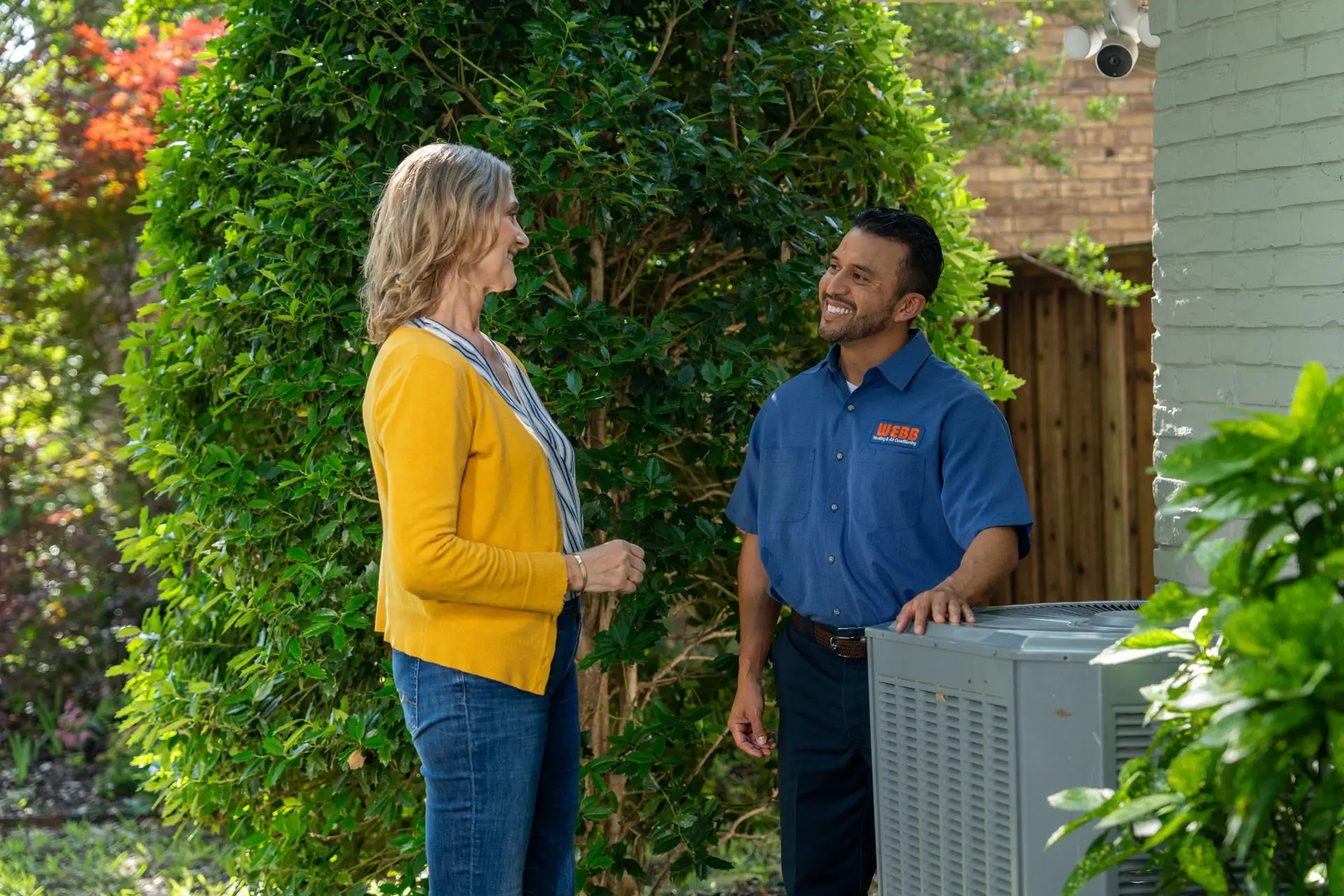
North Carolina summers don't ease you in. By the time May arrives, the Piedmont humidity is already climbing, and by July the heat is relentless enough that a system running anything less than perfectly is going to make itself known fast.
Webb Heating, Air Conditioning & Electrical has been keeping Triad homes cool since 1978, bringing NATE-certified technicians, licensed electrical expertise, and genuine local knowledge to every job.
Schedule Online(336) 439-6150Our Expert AC Services
Webb provides the full range of residential air conditioning services, from emergency repairs to complete system replacements.
- AC Repair: When your system stops cooling, we diagnose and repair broken compressors, frozen coils, refrigerant issues, and other emergencies fast. We service all major brands.
- AC Maintenance & Tune-Ups: Our seasonal precision check is built for North Carolina conditions, including the thorough coil cleaning that the spring pollen season demands and a full inspection before peak heat arrives.
- New System Installation and Replacement: We help Triad homeowners transition to high-efficiency SEER2 systems and heat pumps, with a proper load calculation to make sure the new system is sized right for the home.
- IAQ Services: In a climate this humid, what's moving through your ducts matters. We offer duct sealing, cleaning, and advanced filtration solutions to address air quality and moisture together.
- Electrical Services: As licensed electricians, we inspect your panel and disconnects as part of every service call, something a standard HVAC-only company can't do. Electrical work is available as a standalone service or bundled with any AC job.
Whatever your cooling need, Webb has the equipment knowledge, the certifications, and the local experience to handle it right.
Why Triad Homeowners Choose Webb
Most HVAC companies handle the equipment. Webb handles the whole picture. Our technicians are NATE-certified in cooling and trained on the electrical side, which means we can perform an amperage draw test on your motors, check your disconnects, and verify your panel can support your system, all in one visit.
That dual capability is the Webb advantage, and it's something general HVAC contractors simply aren't licensed to offer.
We're also not a national chain. Webb is based in Advance, in the heart of Davie County, with a full-service location in Greensboro. We've been family-owned for 47 years across three generations.
The neighborhoods we service include the mid-century homes in Starmount and Sedgefield and the newer builds going up in Oak Ridge. These are streets our team drives every day. Read what our customers say on our Reviews page.
Our Air Conditioning Repair Process
Most service calls follow a predictable pattern: a technician shows up, checks the refrigerant, maybe replaces a part, and leaves. Webb's process is more deliberate.
Here's what actually happens when we come out.
Step 1: The Homeowner Interview & Clean Arrival
Our technicians arrive in marked uniforms and put down floor covers before they enter. That's a small thing, but it matters. We're in your home, and we treat it accordingly.
Before we touch anything, we sit down with you for a homeowner interview. How long has it been running this way? Did it start suddenly or gradually get worse? Is it struggling more in one part of the house?
The answers shape the entire diagnostic. Skipping this step means guessing instead of knowing.
Step 2: The Holistic Diagnostic
This is where Webb's dual HVAC and electrical capability makes a real difference. We measure refrigerant superheat and subcooling levels to assess system charge, but we also perform an amperage draw test on your motors and inspect your electrical disconnects.
High amp draw on a blower motor can signal failing bearings, capacitor issues, or restricted airflow, all of which shorten component life if left unaddressed. Checking the disconnects and verifying the panel can support the system's load is something a standard HVAC-only company simply isn't licensed to do.
Step 3: Precision Cleaning & Calibration
In the Piedmont, pine pollen has a waxy, resinous quality that sticks to evaporator coil fins and doesn't rinse off the way ordinary dust does. Left untreated, it restricts airflow and forces the system to work harder than it should.
We perform a thorough coil cleaning, clear the condensate drain of any bio-sludge buildup that the humidity encourages, secure all electrical connections, and lubricate moving parts.
By the end of this step, your system is running the way it was designed to.
Step 4: The Transparency Briefing
Before we close out the call, you get a digital health report covering everything we found and everything we did.
If a repair is needed, you receive an exact price before any work begins, not a range and not an estimate subject to change. This step exists because the last thing anyone wants after a service call is a surprise on the invoice.
Step 5: Post-Service Comfort Check
We don't consider the job done until the system has completed a full operating cycle with us present. That means watching it pull down the temperature, verifying airflow across zones, and confirming it's holding the settings it should be.
If something isn't right, we know before we leave rather than after you call back.
How to Navigate the "Carolina Cooling Cycle"
Piedmont weather creates predictable challenges at three points in the year, and Webb's service is built around all of them.
- The Spring Pollen Attack: Every April, the "yellow haze" from pine and oak trees coats outdoor condenser units and clogs evaporator coils. Unlike ordinary dust, pine pollen has a waxy coating that binds to coil fins and doesn't clear with a simple rinse. A pre-season tune-up with thorough coil cleaning is the most effective protection before peak demand hits.
- The "90-90" Summer Days: When temperatures hit the 90s and humidity follows, oversized AC units in older Greensboro and Winston-Salem homes short-cycle, never running long enough to pull moisture out of the air. The result is a house that reads 74°F but feels clammy. Proper load calculation at installation prevents this. When it's already happening, targeted diagnostic work is how you fix it.
- The Fall Transition: As temperatures drop, dual-fuel systems need to hand off correctly from heat pump to gas backup. We prepare these systems ahead of the first Piedmont frost so the switch is seamless and there are no surprises when you reach for the heat for the first time.
Whatever the season, Webb's service is built around the specific ways this climate stresses a cooling system.
Schedule Online(336) 439-6150Call Webb for Your Air Conditioning Service Needs
From air conditioning service in Greensboro, NC to AC services in Advance, NC, Webb has been the Triad's trusted choice for cooling since 1978. Whether you need a same-day repair, a pre-season tune-up, or a full system replacement, our team is ready.
We also offer Home Service Agreements for homeowners who want priority scheduling and annual maintenance built in, and financing options for larger system investments.
Contact us today or call us at (336) 439-6150 to schedule an appointment!
Frequently Asked Questions
Once a year is the standard recommendation, and spring is the right time to do it. Servicing before peak heat season lets technicians catch problems before they become July breakdowns: worn parts, dirty coils, refrigerant issues.
If your system is older or has a history of problems, twice a year is worth considering.
Yes, and it's more common than you might think. Homes in neighborhoods like Starmount, Lindley Park, and Sedgefield that were built before central air was standard can be retrofitted with high-velocity systems or ductless mini-splits that don't require traditional ductwork.
The right solution depends on your home's layout and what infrastructure is already in place.
A dual-fuel system pairs a heat pump with a gas furnace backup. In the Piedmont Triad, winters are mild enough that a heat pump handles most heating days efficiently, but when temperatures drop hard, gas backup kicks in automatically.
The result is lower energy costs across the full heating season without sacrificing comfort on the coldest nights.